
Designing Content Strategy for 2026
Traditionally, one would create content in the following order: identify themes, topics, and subtopics, then select a specific audience persona, produce content from scratch or use generic AI-generated material, ensure brand voice is carried through, adapt content formats, plan when and where to post, and repeat. However, incorporating fresh perspectives into the ordinary procedure can make content creation more fun and effortless. Technological capabilities, industry advice, and social behaviors are constantly evolving. Who can even keep up with the newest trends? In times when the amount of information is overwhelming, it makes sense to focus on memorable and identity driven ecosystems instead of creating more content. Since your digital attention is so fragile, content that is easier to consume without losing the complex meaning will rival against the viral and brain rot phenomenon. It is crucial to understand why authenticity, structure, and a high-value message win over virality. This article discusses why targeting communities is more impactful than choosing people based on demographics, how brand voice should be replaced with a point of view system (POV), how a multimodal content engine can facilitate content production, and how story environments make a difference.
Understand communities and not the demographics
The emerging trend of people gathering around micro communities signals an opportunity for brands to create niche identities, shared missions, and value based networks. The content is no longer just broadcasted, it is shifting into relationship building among creators and their audiences. The mental construct of a wall between creators and their viewers is diminishing as both sides can gain more from mutual interactions.
Your brand needs to study the behavior of communities instead of single, isolated persona types. To find your preferred audience, you need to aim to understand interests, habits, rituals, content patterns, and micro behaviors, including what they save, binge, comment, and share. Communities can also be grouped into clusters like Problem (Who has the same challenge?), Aspiration (Who desires the same outcome?), Ritual (Who behaves similarly online?), and Worldview (Who believes the same ideologies?). As a result, generic persona profiles based on mere demographic information become obsolete within small niche oriented communities. When you can map a community based on desired interests, pain points, motivations, and communication patterns, you can create content that feels made for them.
Start with a brand POV system, not a personality sheet
The long static PDFs that define how your brand should sound (witty, friendly, professional, etc.) are ready to be replaced by POV systems. A point of view system does not lock you into a tone; it rather clarifies what and how you think by outlining the beliefs you stand for, assumptions you challenge, themes you want to champion, and the lens through which you interpret the industry. While the old brand voice guides focus on how to sound, the POV system supports and justifies why you speak at all. The shift from merely following a brand personality guide to embracing the brand's full potential gives creators more flexibility and an idea driven foundation; instead of memorizing adjectives, you express your worldview. Brand POV gives you a competitive edge, being recognizable, non-replicable, and magnetic to the right audience, especially crucial in an AI saturated web where sameness is an enemy.
To redefine your creative identity, you need to include five essential brand aspects in the POV system. (1) Start by clearly stating the principles your brand considers non-negotiable to guide your brand's moral and intellectual tone. (2) Next, establish a contrary lens to the common practices of industry players. Think of what ideas, truths, and beliefs can be contradicted to prove your distinctive stance because it will create tension, and tension leads to attention. (3) Further, forecast where your field is heading to in the form of a future thesis to not only serve as a voice of today but as a guide into tomorrow. (4) Once you can inspire others with a memorable aspiration, design a signature interpretation style. The rituals, communication techniques, nature of expressions, depth of message, specific themes, and other creative ideas will signal immediate recognition among noisy and chaotic content pieces. (5) Finally, define your creative territory in terms of what is important to your brand, what you can create, and what your audience values. You need to understand what topics or directions should be intentionally avoided and where your brand can excel on a greater scale.
While most brands do not explicitly name their approach a POV System, leading brands demonstrate it implicitly:
Apple POV: Creativity belongs to everyone. Their content highlights intuitive tools, empowerment, and human potential.
Patagonia POV: The planet comes before profit. Their content blends activism, transparency, and anti-consumerist stances.
Duolingo POV: Learning should be chaotic and fun. Their playful, unpolished style signals their rejection of traditional corporate ed-tech aesthetics.
Notion POV: Tools should adapt to people. Their ecosystem content reflects possibility, personalization, and modularity.
Building a multimodal content engine
It is a common practice among creators to repurpose existing content for various platforms and formats, while efficient at first sight, the result often feels bland, recycled, and out of place because it was not designed for that medium in the first place. You do not have to repeat the same message in different words; instead of taking one big piece and slicing it down, you take one core idea and build multiple, native format interpretations of that idea. A multimodal content engine reframes topics, giving variety, depth, and fresh perspectives with added details. Practically, the strategy of chasing trends and constantly generating new ideas to demonstrate different angles of the same concepts makes your content richer and easier to produce consistently. This approach helps your message to be better perceived, as people have various content consumption preferences without repeating the same thing everywhere.
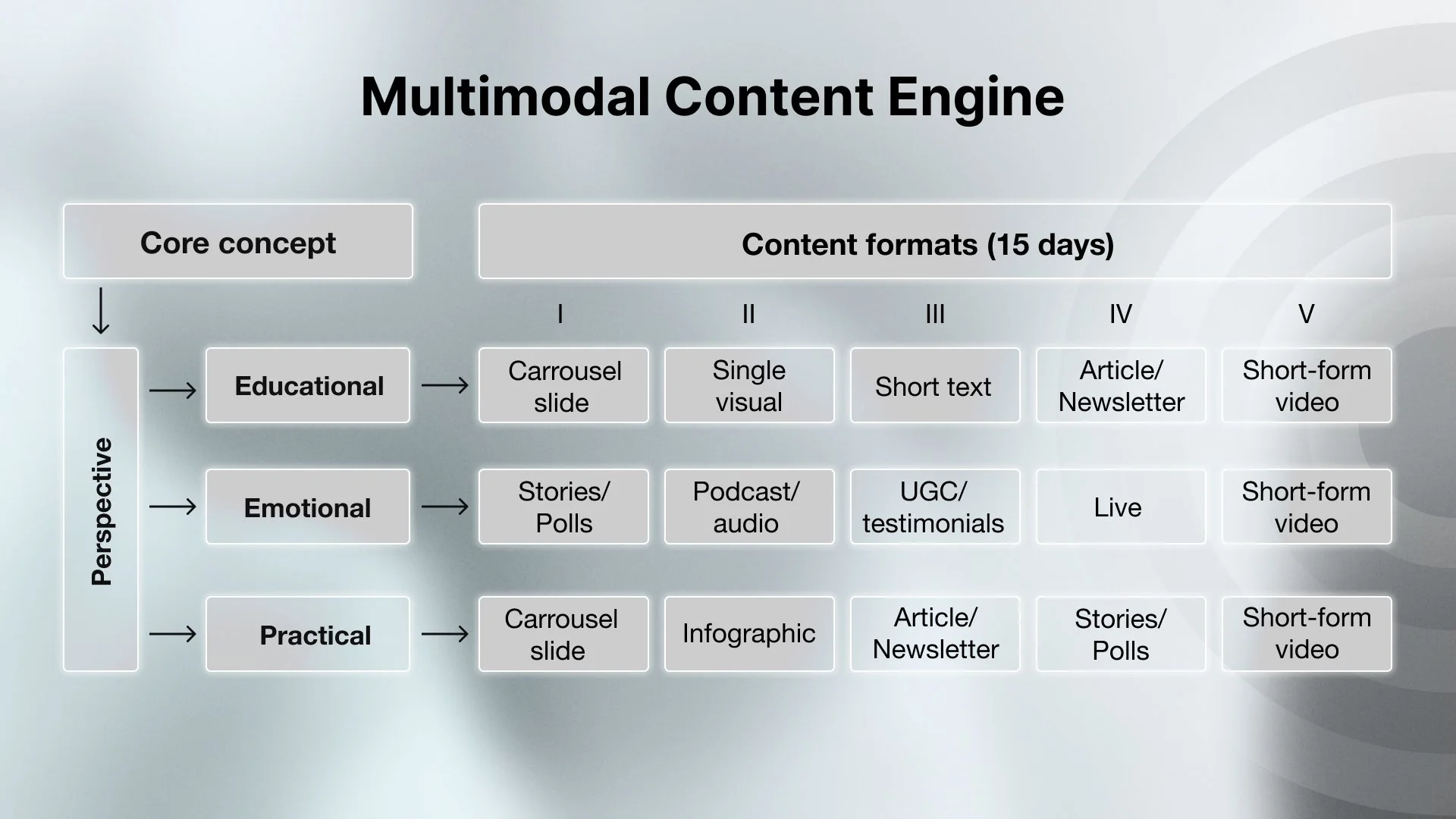
To create a modular content engine, you need to structure it in 3 steps:
Find one weekly or bi-weekly idea/ concept
Break this idea into 3 angles: educational, emotional, & practical
Address the following questions for each perspective:
Educational:
What is this concept, and why does it matter?
How can I break this idea into 3–5 simple steps or a mini-framework?
What problem does this concept solve?
What are the biggest misconceptions about this concept?
What evidence or examples illustrate this idea?
How does this concept fit into the bigger picture?
Emotional/ Interactive:
What simple, playful choice can I ask them to make, so they feel involved
What is a fun, low-effort way for my audience to express their identity through this idea?
What question would spark a personal story or small confession from my audience?
How does someone feel before and after applying this idea/ concept?
What emotional tension or contrast can I highlight to promote interaction?
Practical:
What is the quickest, easiest first step to take to try this idea?
How can I show a mini-demo of this idea in action?
What simple tools and frameworks help apply this idea today?
What mistakes should be avoided when using this idea?
What does a basic vs. upgraded version of this idea look like?
4. Choose and create 5 micro assets for each angle based on the social media platforms your brand uses:
Carousel slides (compelling visuals with text, infographics, photos)
Single visual with a strong caption
Micro stories with a personal touch
User generated content with context
long article/ newsletter
Podcast/ Spaces (X)
Live
Short text (X, LinkedIn)
A question
A quote
Thought leadership/ insight
Short form video
guides/ how it is made
behind-the-scenes snippets
reactions
reels
Tools that support the engine:
Notion / Asana / Trello: organize core ideas, angles, and asset lists
Figma / Canva: create reusable branded templates and graphic designs
CapCut / Descript: produce fast, native-feeling short videos
Miro / FigJam: conceptual mapping for ideas and story environments
TikTok creative center / IG insights: platform-native behavior insights
The format of content is not accidental or repeated because of trends; it is chosen to match the expression with the overall purpose. For example, use text for depth, short-form videos for reach, audio for more intimate moments, and interactive content for engagement. To decide on the right format, you need to understand what you are communicating and what you want to achieve.
Designing story environments
The strategies for telling stories are no longer a secret; what keeps brands fresh and interesting to their audiences are the dynamics, added dimensions, and evolving perspectives. Instead of thinking of stories as linear flows and one-off pieces, we can create running characters, worlds, and recurring formats. Defining the thematic groups and creating stories based on predefined areas of expertise can only prove the depth of knowledge as more content is produced. Think of story environments as multi-layer components consisting of territory (your expertise + interest + what you avoid), key characters (your brand, your employees, your customers), and events (achievements, learning, future vision). When crafting the story environments, start by describing the characteristics. While it is obvious to have stories in one domain with a character encountering a specific event, the possibilities and limitations of each element are not always clear or understood. Communicating the dimensions of your stories can consistently help your audience to picture, emphasize, and share the messages. The multimodal content engine combined with the story environment becomes a powerful method to experiment, learn, and deliver value in a structured and more thoughtful way.
